The Attack and Death of Y·N’s Adoptive Mother
Living with 7 vampiresThe Attack and Death of Y/N’s Adoptive Mother marks the moment when Y/N’s painful domestic past becomes inseparable from the supernatural mystery surrounding her identity. At sixteen, Y/N has understood herself as a girl rejected and mistreated by the people she calls her parents, yet an involuntary telephone call draws her back toward the old home. There, the opened door, the blood on the floor, the dying woman’s warning, and the necklace left in her hand transform private family trauma into an investigation involving concealed parentage, violence, and forces Y/N does not yet understand.
The Call and the Return
Without consciously deciding to do so, Y/N calls her mother. The conversation quickly becomes threatening when an unidentified speaker recognizes the woman as Y/N’s mother and asks who she is. The interruption is followed by the mother’s scream, the sound of the telephone and someone falling, and a silence that leaves Y/N without an explanation. Although Y/N reminds herself that her parents abused her for a long time and questions why she should care, she takes the phone and runs out of her room. Her movement is therefore driven by a conflict between remembered injury and an immediate obligation to witness what may have happened.
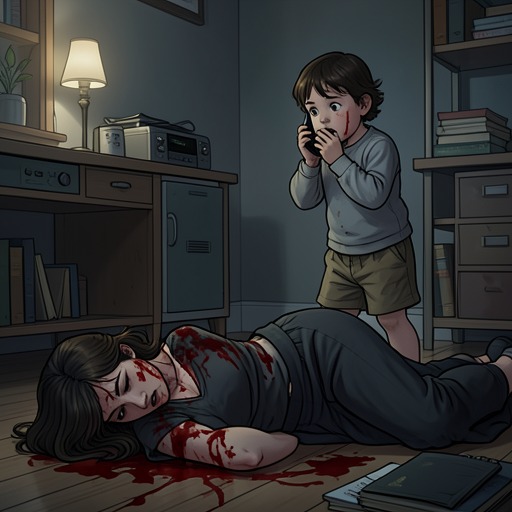
Y/N travels to the house, thanks the driver, and runs to the entrance. The door has been broken open, providing the first visible sign that the crisis was caused by an intrusion rather than an ordinary family quarrel. Inside, she finds her mother on the ground in a pool of blood. The scene turns the old home from a place associated with abuse into a crime scene and forces Y/N to confront the physical reality of the violence that had begun over the telephone.
The Mother’s Last Warning
Y/N sits beside her mother and lifts her head, finding her still alive but already close to death. The wounded woman’s speech is broken and difficult to hear: she tells Y/N to stop calling her mother and directs her toward a book in the desk. The instruction is both rejection and disclosure. Even while denying the maternal title, she points Y/N toward an object that may explain the life hidden from her. Y/N briefly recognizes that the woman might survive, but life soon leaves her eyes; she stops moving and speaking, and Y/N can find no pulse. The attack therefore ends not only in death but in an unanswered transfer of knowledge, with the final clue placed inside the same home that had concealed the truth.
The Necklace and the Discovery of Adoption
After leaving the house and then returning downstairs, Y/N notices that her mother’s body lies in a different position from before. The change reveals that the dying woman had moved or acted during the brief interval, and that she had retained one final object: a necklace in her hand. Y/N picks it up and holds it close, turning the necklace into both a personal remnant of the dead woman and a material clue to the attack. Her grief immediately acquires a purpose as she resolves to discover who was responsible.
The necklace’s significance expands when Y/N later confronts the possibility that the woman was not her biological mother. The revelation strikes at the identity Y/N had been forced to inhabit: she is sixteen, has been abused and rejected within the household, and has already been treated by the vampires as a potential blood vessel rather than as a person. Her question about who her real parents are and why they abandoned her converts the murder investigation into an origin investigation. The dead woman’s final instructions, the necklace, and the concealed record in the desk together establish that Y/N’s family history was deliberately hidden rather than merely forgotten.
Consequences for Y/N’s Agency
The attack leaves Y/N with no reliable parent, no complete account of her birth, and no clear explanation for the violence. Yet the event also begins a gradual reversal in her position. She is repeatedly exposed to forces that claim authority over her body: a vampire drinks her blood, another calls her the only blood vessel available, and later supernatural dangers injure, examine, or transform bodies around her. Against that pattern of possession, her decision to retrieve the necklace and pursue the truth is an early act of self-directed investigation. The scene does not make her powerful at once; it gives her an unanswered question and an object through which to pursue it.
That question later becomes inseparable from the supernatural conflict. When Y/N chooses to save the trapped vampires rather than prioritize learning who or what her parents are, she places immediate solidarity above personal revelation. Much later, confronting Gehan, she breaks the chain restraining her with a movement of her arm and asks why he is afraid of his own daughter. The maternal attack thus functions as an early hinge in a larger identity arc: the girl who begins by discovering that her family story has been falsified eventually identifies herself within the very supernatural lineage that made the concealed truth dangerous.
Narrative Function and Thematic Significance
The attack is presented through Y/N’s restricted experience rather than through an explanation of the attacker, so its immediate meaning is created by fragments: an involuntary call, an unknown voice, a scream, a broken-open door, blood, interrupted speech, and a necklace. This structure makes the event a trauma of witnessing as much as a murder. Y/N cannot prevent the violence, obtain a full account of it, or receive an uncomplicated farewell; instead, she must assemble its significance from sounds, bodily evidence, and objects left behind. The mother’s command to look in the desk and the necklace in her hand turn the scene into a threshold between bereavement and investigation, while the discovery that Y/N was adopted destabilizes the family identity that had organized her suffering. The event also establishes a recurring contrast in the larger narrative between bodies treated as vulnerable resources and bodies that eventually resist control. Y/N is first exposed to blood-drinking, the language of the “blood vessel,” injury, examination, and supernatural restraint, but her later choice to save others, her physical breaking of Gehan’s chain, and her accusation that he fears his own daughter show how the unanswered violence becomes part of a movement toward agency. The mother’s death therefore remains both an ending and an origin: it closes Y/N’s connection to the household that abused her, while opening the hidden lineage, supernatural conflict, and contested inheritance that define her subsequent trajectory.